Posts

Showing posts with the label anime

Disaster Report: MY SISTER, MY WRITER

Image
Is there any anime trend more regrettable than the imouto (little sister) romance? It started off simply enough, as creators in the late 2000s sought a way to distinguish their otaku-friendly harems and rom-com light novels from the rest of the crowd.  It was the perfect fantasy for lazy, jaded otaku: here’s a cute younger girl who keeps house for you, already has an implicit relationship with you, brings an element of cultural taboo, and all of it is available without having to leave the house (or the family tree)! It soon made the shift from doujin and light novels to bargain-bin ecchi shows like Kiss X Sis and I Don’t Like You At All, Big Brother .  The closest it ever got to mainstream acceptance was 2012’s Oreimo .  Its fandom grew steadily over the course of its two seasons (plus OVAs), even as it steadily denied that it was anything like those other little sister shows (at least, until it all ended with its bl...

Disaster Report: TRY KNIGHTS

Image
You know, I've largely dedicated this column to document anime failures of the past but there are plenty of modern shows that are equally broken, thanks to the absolute glut of shows we get every season and the increasingly tenuous and untenable conditions under which they are made.  This is just one of them. For the last decade, countless anime studios have been trying to create their own version of Free! .   That’s perfectly understandable, considering that series not only brought a lot of acclaim to Kyoto Animation but also made a LOT of merchandise money thanks to its fervent fujoshi audience.   This wasn’t the first time fujoshi turned a sports anime into a success – this has been a phenomenon in Japan since the days of Captain Tsubasa , repeated time and again with the likes of Slam Dunk and The Prince of Tennis .   The difference this time was international audience responded just as strongly, in defiance of the common knowledge within the industry that sport...

Disaster Report: EL HAZARD - THE WANDERERS

Image
There are a lot of reasons I cover shows here on Disaster Report.   Some of them are famous failures.   Others are shows I wouldn’t even know about if not for friends and mutuals.   A few end up here because they manage to thread that magical, metaphorical “so bad it’s good” needle. Sometimes, though, it’s entirely personal.   That is certainly the case for 1995’s El Hazard: The Wanderers .

Disaster Report: TENCHI IN TOKYO

Image
AIC produced a lot of hits over the years, but few of them could compare to the success and impact of the 1992 OVA Tenchi Muyo! .  What began as merely a sitcom-inspired AU starring a minor character from Bubblegum Crisis made in part to sell Pioneer laserdiscs became a landmark in the growing genre of harem anime and an international sensation in its own right.  For AIC, it was the goose that laid golden eggs, and each new egg was a success in its own right.  One OVA soon became two, which was followed in turn by the full length TV series Tenchi Universe .  From there the franchise branched out into various films, specials, OVAs, and spinoffs. Sadly, no anime franchise can succeed forever and Tenchi Muyo was no exception.   It has stumbled many times over the last 30 years, and many of its latter day installments would be a perfect fit for this column.   That would be a little too easy though, even for me.   I was more interested in determining the ...

Disaster Report: RECORD OF LODOSS WAR: CHRONICLES OF THE HEROIC KNIGHT

Image
The 1980s are considered by many to be the glory days of the anime OVA, but the 1990s was no slouch for the format either.  While the number of OVAs decreased due to Japan’s economic recession and changing trends in media, there were plenty of excellent, influential, and fondly remembered OVAs that came out during that decade.  That being said, in the 1990s animation studios began to view OVAs less as a place to experiment and more like the seed of a potential new franchise, complete with a TV-length adaptation.  Over the next few months, I’m going to be exploring how three very different OVAs got lost in translation in their transition to television in the late 1990s, all at the hands of the same animation studio.  Let’s begin with the oldest of these OVAs: Record of Lodoss War .

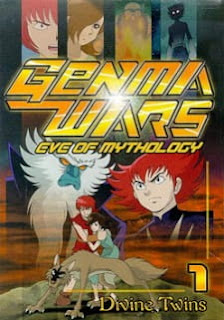
Disaster Report: GENMA WARS TV

Image
This review was commissioned by @zawa113CJ .  Thanks! In the early 2000s, there was a sudden urge within the anime industry to take stories from the manga world’s most acclaimed creators and turn them into shiny new anime for a shiny new millennium.   During those first few years of the decade, there were both remakes and new adaptations of works by Osamu Tezuka, Mitsuteru Yokoyama, and Leiji Matsumoto just to name a few.   Also included in that list was the extremely prolific (and then-recently deceased) mangaka Shotaro Ishinomori. The decade had started off strongly for Ishinomori fans.   In 2000, Kamen Rider Kuuga helped to reboot the franchise that Ishinomori helped create after a 13 year hiatus.   2001 would see animated adaptations of both Cyborg 009 and Android Kikaider , both of which were successful enough to get licensed in America and even air on TV.   It’s no surprise that others would want to capitalize on these two trends by producing 2002’s...

The Story of Animerama: Legacy

Image
The Animerama trilogy officially ended in 1973 with the failed release of Belladonna of Sadness and the closure of Mushi Productions.  That was far from the end for Osamu Tezuka and Eichi Yamamoto, the men who had helped bring that troubled trilogy into the world.   While both found success in their post-Mushi careers, that success took them down very different paths.   It wasn't even the end for Mushi Productions itself.   Meanwhile, the Animerama films themselves would linger in obscurity for decades, waiting for a time when the world would be more receptive to what they had to offer.

The Story of Animerama: Belladonna of Sadness

Image
 By 1971, things looked grim for both the Animerama project and Mushi Productions.  Cleopatra had flopped, Tezuka had resigned from the studio in shame, and the studio's finances were more desperate than ever.  It was during this time that Eiichi Yamamoto would create the final Animerama film: Belladonna of Sadness .  After years of trying to realize Tezuka’s visions, it was finally time for him to demonstrate what he was capable of as a director.  Belladonna would unite its unconventional source material, a handful of outside talent, and the limited resources of a dying studio to create a film unlike anything else in anime, before or since. __________________________ Strictly speaking, Belladonna of Sadness is not an Animerama film.   While there were vague plans for a third film when the project was first conceived, these were never fully developed.   The true inspiration behind this film was the famous animated adaptation of The Beatles’ Yell...

Disaster Report: MIRACLE TRAIN - WELCOME TO THE OEDO LINE

Image
 Japan is famous worldwide for its ability to anthropomorphize anything for the sake of promotion.  People have written literal books on the subject, and the variety and specificity of their many, MANY mascots is a common subject of lighthearted ridicule online.  Not even anime is safe from this  phenomenon.  They’ve made anime about headphone mascots, pop cans, and the nations of the world, just to name a few.  There’s only one series that dares to give that sort of treatment to a Tokyo train line, though: 2009’s Miracle Train: Welcome to the Oedo Line .

The Story of Animerama: Cleopatra

Image
  A Thousand and One Nights didn’t come together quite as smoothly as Osamu Tezuka and Eiichi Yamamoto hoped, but they did manage to make a commercially successful film that captured some of the rebellious, experimental spirit of Mushi Production’s early days.  That experience meant that things could only improve for their next Animerama feature.  After all, they had an absolute slam dunk of a premise: the story of Cleopatra and her infamous affairs with Julius Caesar and Marc Antony.  With Tezuka at the helm and an experienced crew behind him, there was no way this could fail! Yet Cleopatra  would fail, due to factors both within and outside of Tezuka’s control.   Its failure marked the beginning of the end for both the Animerama project and Mushi Productions, and it would coincide with the lowest point in Tezuka’s animation career. ________________________ While Tezuka was generally pleased with how A Thousand and One Nights turned out, he was stil...